Choosing a men’s hair styling product can feel harder than choosing the haircut itself. Matte clays and sea salt sprays are both popular for modern textured hairstyles, but they perform very different jobs. If your goal is a hairstyle that looks natural and stays in place, understanding the difference can save you from using too much product or choosing the wrong formula.
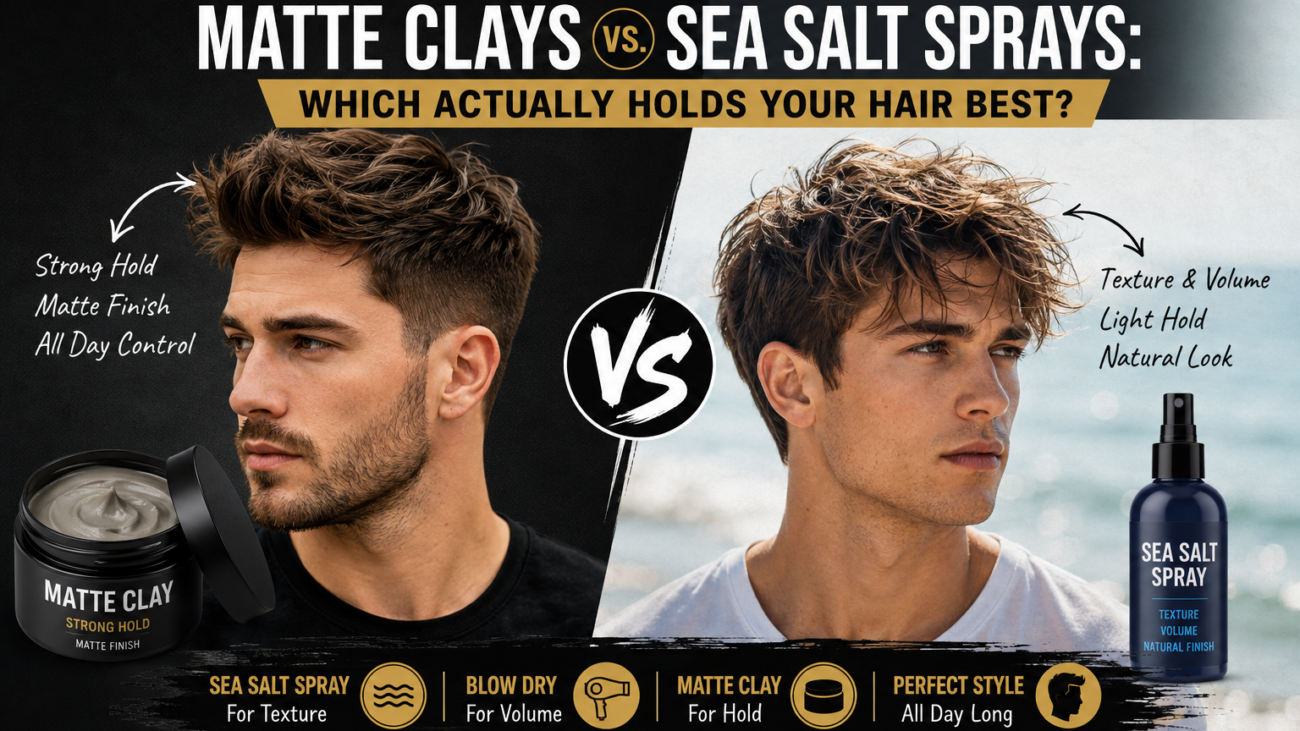
The simple answer is this: matte clay generally provides stronger styling control and hold, while sea salt spray is better for creating texture, volume, grip, and movement. Sea salt spray is commonly used as a preparation step on damp hair, while clay is typically used on dry hair to shape and control the finished style.
If you’re searching for a Barber Near Me because your current style never seems to hold properly, the solution may not be a stronger product. Your haircut, hair type, application technique, and styling routine all affect how long your look lasts.
The 5-4-3-2-1 Rule for Choosing Your Styling Product
Let’s break down the decision using a simple 5-4-3-2-1 system.
5 — Five Things to Consider Before Choosing a Product
Before buying matte clay or sea salt spray, consider these five factors:
- Hair type — Is your hair fine, thick, straight, wavy, or curly?
- Hair length — Short hair often responds differently from medium or longer hair.
- Desired hold — Do you want flexible movement or stronger control?
- Finish — Do you prefer matte, natural, textured, or slightly shiny hair?
- Hairstyle — A textured crop, messy fringe, quiff, and slick style can require different products.
The right product is therefore not necessarily the one with the strongest label. It is the one that matches the job your hairstyle actually needs.
4 — Four Major Differences Between Matte Clay and Sea Salt Spray
1. Hold
This is the biggest difference.
Matte clay:
Clay is generally the better choice when you want your hairstyle to stay shaped throughout the day. It provides stronger control and helps maintain direction and definition.
Sea salt spray:
Sea salt spray primarily creates texture, grip, and volume. It usually provides lighter control rather than the stronger finishing hold associated with clay.
Winner for hold: Matte clay
2. Texture
Sea salt spray has a major advantage when the goal is natural-looking texture.
It can give hair separation and grip, making flat or overly soft hair easier to style. It is particularly useful for messy, loose, textured, and casual hairstyles.
Matte clay also creates texture, but its primary purpose is shaping and controlling the hair.
Winner for lightweight texture: Sea salt spray
3. Volume
If your hair tends to sit flat against your head, sea salt spray can be useful as a pre-styling product. Applied to damp or towel-dried hair and then dried into shape, it can provide additional body and grip.
Clay can create the appearance of fuller, more structured hair, but applying too much can make some hairstyles feel heavy.
Winner for initial volume: Sea salt spray
4. Finish
Matte clay is designed for a low-shine or matte appearance, making it suitable for modern textured cuts where you don’t want an obviously glossy product finish.
Sea salt spray typically produces a natural, dry, textured appearance rather than the polished shine associated with traditional pomades.
Winner for a strong matte finish: Matte clay
3 — Three Hair Types That Can Benefit From Each
Fine or Flat Hair
Fine hair often needs texture and grip before it needs heavy control.
A light application of sea salt spray can help create separation and body before blow-drying. Once the hair has shape, a small amount of matte clay can provide additional definition.
Best approach: Sea salt spray → blow-dry → small amount of clay.
Thick, Straight Hair
Thick straight hair can look excellent but may resist staying in the desired direction.
This is where combining the two products can make sense. Sea salt spray can provide the initial grip, while clay can provide the finishing control.
Best approach: Sea salt spray for preparation + clay for hold.
Wavy or Naturally Textured Hair
If your hair already has natural movement, sea salt spray can emphasize that texture and create a relaxed appearance. If you want the waves or textured shape to remain more controlled, add a small amount of clay after drying.
Best approach: Sea salt spray for movement + clay for definition.
2 — Two Products, Two Different Jobs
One of the biggest mistakes men make is treating these products as direct substitutes.
They’re not.
Think of them as two different stages of styling:
Sea Salt Spray = Preparation
Apply it to damp or towel-dried hair. Work it through the hair and then blow-dry or air-dry according to the desired style.
Its purpose is to create:
- Texture
- Grip
- Separation
- Body
- Natural movement
Matte Clay = Control
Apply clay primarily to dry hair after the basic shape has been created.
Its purpose is to provide:
- Definition
- Direction
- Stronger control
- Matte finish
- Longer-lasting structure
This distinction is why many stylists recommend using the products together rather than asking which one completely replaces the other.
You might also like: Tired of Razor Bumps? Why You Need a Professional Hot Towel Shave This Week
1 — The One Simple Rule to Remember
If your problem is texture, start with sea salt spray.
If your problem is hold, reach for matte clay.
And if you need both?
Use sea salt spray first and matte clay second.
This simple sequence can create a more reliable styling routine without loading your hair with unnecessary product.
Matte Clay vs. Sea Salt Spray: Quick Comparison
| Feature | Matte Clay | Sea Salt Spray |
|---|---|---|
| Primary purpose | Shape and control | Texture and grip |
| Hold | Medium to strong, depending on formula | Light |
| Finish | Matte | Natural/textured |
| Volume | Moderate | Good for pre-styling |
| Best application | Dry hair | Damp/towel-dried hair |
| Texture | Defined | Loose and natural |
| Best for | Controlled textured styles | Messy, loose, natural styles |
| Can be combined? | Yes | Yes |
These are general product-category differences; individual formulas can vary considerably.
How to Use Matte Clay Correctly
Even a good clay can fail if you apply too much.
Step 1: Start With Dry Hair
Clay generally works best when the hair is dry because it is being used to shape and control an already-created style.
Step 2: Use a Small Amount
Start with a small quantity. You can always add more, but removing excess product is much harder.
Step 3: Warm It Up
Rub the clay between your palms before applying it. This helps distribute the product more evenly.
Step 4: Work From Back to Front
Spread the product through the hair rather than putting a large amount directly onto the front.
Step 5: Shape With Your Fingers
Use your fingers to create separation and definition. For a more structured look, use a comb after distributing the product.
Step 6: Add Only if Necessary
If the style needs more control, add a little more product rather than applying a large amount at once.
How to Use Sea Salt Spray Correctly
Sea salt spray is usually most useful before the final styling stage.
Step 1: Towel-Dry Your Hair
Don’t apply it to hair dripping with water. Start with damp or towel-dried hair.
Step 2: Spray Evenly
Use a controlled amount throughout the areas where you want texture and grip.
Step 3: Work It Through
Use your fingers to distribute the spray.
Step 4: Blow-Dry Into Position
For additional volume, direct the hair upward or into the desired shape while drying.
Step 5: Finish With Clay if Needed
If you need more definition or hold, use a small amount of matte clay once the hair is dry.
Using sea salt spray as a foundation and clay as the finishing product is a practical way to get both texture and control.
What About a Haircut? Your Product Can’t Fix Everything
A styling product can improve your hairstyle, but it cannot completely compensate for a haircut that doesn’t suit your hair type.
For example, extremely heavy hair can collapse despite using strong product. Likewise, very fine hair may become weighed down when too much clay is applied.
That’s why a professional consultation matters.
If you’re looking for a Haircut Simcoe, discuss your hair’s natural direction, density, texture, and the amount of daily styling you’re willing to do. A barber can adjust the cut so your styling product works with the hair instead of fighting against it.
Why Your Hairstyle Loses Hold During the Day
If your hair looks perfect in the morning but collapses by lunchtime, several factors could be responsible.
Too Much Product
More product does not automatically mean more hold. Excess product can weigh hair down and make it difficult to maintain volume.
Wrong Product
If you need strong control but are relying only on sea salt spray, the problem may be the product category rather than the amount.
Wrong Application
Applying clay to overly wet hair can reduce its ability to provide the intended finish and control.
Incorrect Haircut
A haircut with excessive weight in the wrong areas can make styling unnecessarily difficult.
Oil and Product Buildup
A buildup of styling products or excess scalp oil can affect how hair behaves and how products distribute.
When You Should Use Both
For many modern men’s hairstyles, you don’t necessarily have to choose between clay and sea salt spray.
A useful routine can look like this:
Morning shower → towel-dry → sea salt spray → blow-dry → matte clay → final shaping
This combination can work particularly well when you want both natural texture and stronger control.
For example, imagine a textured crop:
- Sea salt spray creates initial separation.
- Blow-drying builds the basic direction.
- Matte clay adds definition.
- Fingers create the final texture.
- A light finishing spray can be added if extra hold is needed.
The key is using each product for its intended purpose rather than overusing one product to do everything.
Choosing the Right Product for Popular Men’s Hairstyles
Textured Crop
Best choice: Sea salt spray + matte clay
Use the spray to create texture and the clay to define the individual sections.
Messy Fringe
Best choice: Sea salt spray
If additional control is required, finish with a small amount of clay.
Classic Quiff
Best choice: Sea salt spray + clay
The spray helps create body while clay provides definition and control.
Short Textured Fade
Best choice: Matte clay
Short textured hair often benefits from a product that emphasizes separation and provides stronger control.
Natural Wavy Style
Best choice: Sea salt spray
The goal here is usually to enhance existing movement rather than force the hair into a rigid shape.
Getting Professional Advice at MEN ZONE
Finding the right product is easier when you understand your haircut first. Men Zone focuses on men’s haircuts and grooming, so a professional consultation can help you choose a styling routine based on your hair type, cut, and desired finish.
For men searching for a Barber Simcoe, a professional barber can also show you exactly how much product to use and where to apply it instead of leaving you to experiment with different products at home.
You can visit MEN ZONE Barbershop at 2625 Simcoe St N Unit# 2, Oshawa, ON L1L 0R8, Canada for a professional men’s haircut and grooming service.
Common Styling Mistakes to Avoid
❌ Using Too Much Clay
Start small and build gradually.
❌ Expecting Sea Salt Spray to Provide Strong Hold
Sea salt spray is primarily a texturizer and preparation product, not a replacement for a strong finishing product.
❌ Applying Clay to Soaking-Wet Hair
Allow your hair to dry sufficiently before using clay for final control.
❌ Spraying Too Much Salt Spray
More spray can make hair feel overly dry, stiff, or gritty.
❌ Ignoring Your Haircut
The right product cannot completely compensate for a poorly suited cut.
❌ Copying Someone Else’s Routine
Your friend’s hair may be completely different from yours. Product selection should be based on your own texture, density, length, and hairstyle.
Frequently Asked Questions
1. Is matte clay stronger than sea salt spray?
Generally, yes. Matte clay is designed primarily for shaping and control, while sea salt spray is mainly used to create texture, grip, and volume. Individual products vary, but clay is normally the better choice when stronger hold is the priority.
2. Can I use sea salt spray and matte clay together?
Yes. In fact, they can complement each other well. Apply sea salt spray to damp hair as a preparation step, dry the hair into shape, and then use a small amount of matte clay to add definition and control.
3. Is sea salt spray good for fine men’s hair?
It can be useful for fine or flat hair because it adds texture and grip without requiring a heavy finishing product. However, the amount used should be controlled so the hair does not become overly dry or stiff.
4. Is matte clay good for thick hair?
Yes. Matte clay can be particularly useful when thick hair needs more direction and control. For very dense hair, using sea salt spray first can provide additional grip before the clay is applied.
5. Should sea salt spray be used on wet or dry hair?
Sea salt spray is generally used on damp or towel-dried hair before drying and styling. Applying it during this preparation stage helps create texture and grip.
6. Should matte clay be applied to wet hair?
Matte clay is generally better suited to dry hair when you want to shape and control the finished hairstyle. Starting with dry hair also helps you judge how much product you actually need.
7. Which product is best for a messy hairstyle?
Sea salt spray is a strong starting point when you want loose, natural texture and movement. If the messy style needs more definition or staying power, add a small amount of matte clay.
8. Can sea salt spray damage hair?
Using styling products excessively can contribute to dryness or an undesirable feel, particularly if the formula or routine doesn’t suit your hair. Use a moderate amount and maintain a sensible cleansing and conditioning routine.
9. Why does my clay stop holding my hair?
Possible reasons include using too much product, applying it incorrectly, excessive oil or buildup, unsuitable hair length, or a haircut that carries too much weight. A barber can often identify whether the issue is the product or the haircut.
10. Which should I choose: matte clay or sea salt spray?
Choose matte clay when your priority is hold, shape, definition, and a matte finish.
Choose sea salt spray when your priority is texture, volume, grip, and natural movement.
If you want both, use sea salt spray first and matte clay second.
Final Verdict: Which Actually Holds Your Hair Best?
If the question is strictly “Which product holds my hairstyle better?”, matte clay is usually the winner.
But if the question is “Which product helps me build a hairstyle that looks textured and lasts longer?”, the answer may be both.
Sea salt spray creates the foundation by adding texture and grip. Matte clay then takes over by providing shape, definition, and stronger control.
So remember the 5-4-3-2-1 rule:
5 — Consider your hair type, length, style, finish, and desired hold.
4 — Understand the differences between texture, volume, finish, and control.
3 — Think of spray as preparation, clay as shaping, and your haircut as the foundation.
2 — Use two products together when you need both texture and hold.
1 — Choose the product based on what your hair actually needs, not what the label promises.
A great hairstyle starts with the right haircut and becomes easier when your styling products are working with your hair instead of against it.